Why 200W? The Perfect Balance of Power and Portability
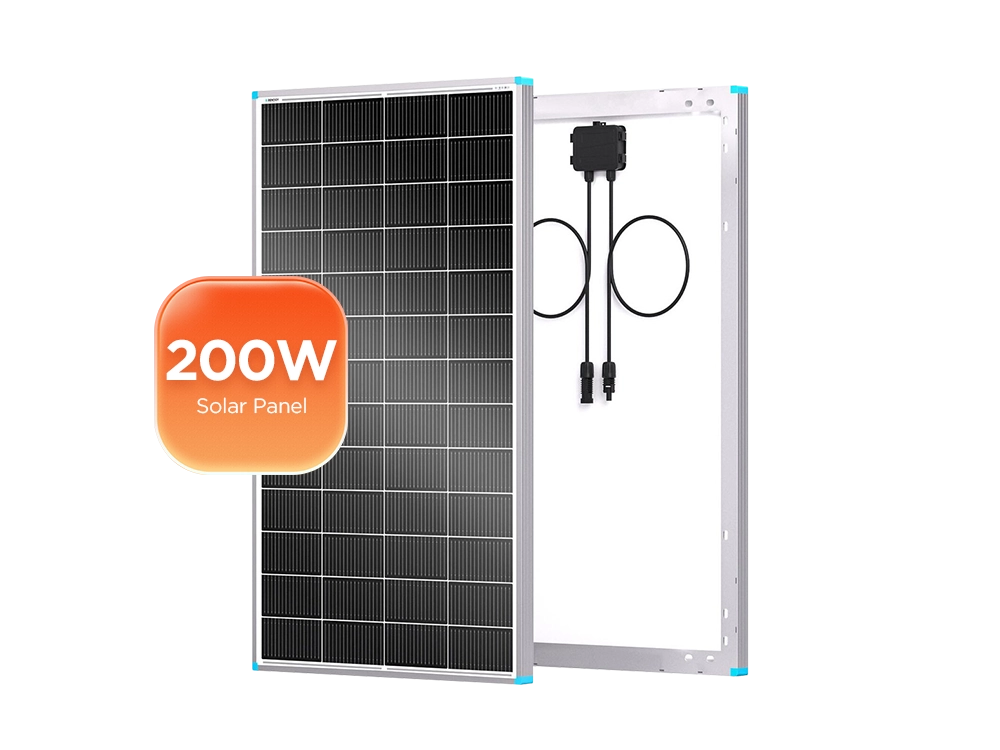
A 200W solar panel represents the sweet spot for off-grid power. Unlike smaller 100W panels that require multiple units to get meaningful power, or larger 400W+ panels that are heavy and hard to mount, 200W panels deliver substantial power in a size that fits most RV roofs, boat decks, and cabin installations.
Whether you’re powering LED lights and a water pump in your RV, maintaining batteries on your boat, or running a small refrigerator in an off-grid cabin, this 160W-200W series gives you the power you need without taking up your entire roof.
Available in 8 power options – 160W, 165W, 170W, 175W, 185W, 190W, 195W, and 200W – so you can choose exactly what fits your space and energy needs.
What Can You Expect in Real-World Conditions?
Solar panel ratings are measured in perfect laboratory conditions (STC). In real life, here’s what our customers actually get:
Condition Expected Output (200W panel) Best for
🌞
Peak sunny 160-190W (80-95%) Arizona, Texas, California summers
🌤️
Partly cloudy 80-120W (40-60%) Most US regions, average days
🌙
Early morning / late evening 20-60W (10-30%) Extended daylight
☁️
Overcast 10-40W (5-20%) Still works – keeps batteries topped
Daily energy production varies by region:
Region Summer Daily Winter Daily Annual Avg Southwest US (AZ, NV, CA) 1,000-1,200 Wh 600-800 Wh ~900 Wh Southeast US (FL, TX, GA) 800-1,000 Wh 400-600 Wh ~700 Wh Northeast US (NY, PA, ME) 600-800 Wh 200-400 Wh ~500 Wh Pacific Northwest (WA, OR) 700-900 Wh 150-300 Wh ~450 Wh Bottom line: One 200W panel produces 600-1,200 watt-hours daily depending on where you live and the season. That’s enough to run LED lights, charge devices, power a fan, and maintain your batteries – every single day.
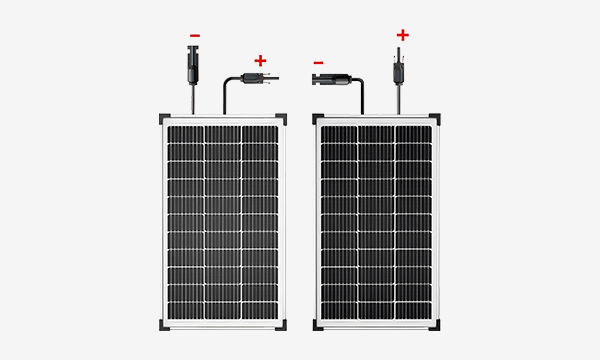
Series Connection
Solar panels can be connected inseries to produce the desiredvo
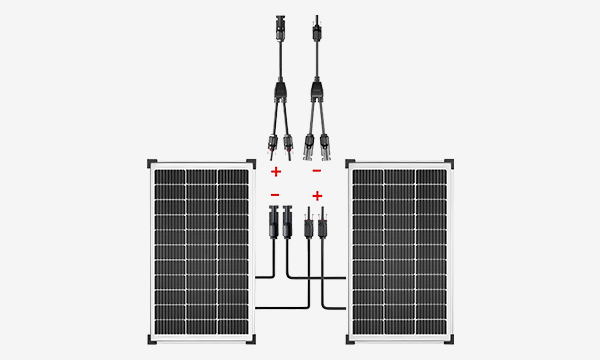
Parallel Connection
Solar panels can be connectedin parallel to produce thedesired
Technical Data
Parameter
160W
165W
170W
175W
185W
190W
195W
200W
Cell Type
Mono
Cell Size
210mm
Pmax (W)
160
165
170
175
185
190
195
200
Vmp (V)
19.06
19.63
20.3
20.5
21.6
21.83
22.17
22.48
Imp (A)
8.4
8.41
8.38
8.54
8.56
8.7
8.8
8.9
Voc (V)
22.24
22.91
23.69
23.79
25.26
25.53
25.93
26.29
Isc (A)
8.89
8.9
8.87
9
9.02
9.17
9.27
9.37
Efficiency (%)
17.61
18.16
18.71
19.26
18.65
19.16
19.66
20.17
Dimensions (mm)
1180×770
1180×770
1180×770
1181×770
1485×668
1485×668
1485×668
1486×668
Weight (kg)
9.54
9.54
9.54
9.54
10.5
10.5
10.5
10.5
Junction Box
IP67
Connector
MC4
Cable
50cm
Snow Load (Pa)
5400
Wind Load (Pa)
2400
Max System Voltage
1500V
Max Fuse Rating
10A
10A
10A
10A
15A
15A
15A
15A
Operating Temp
-40~85°C
Certification
TUV
Elemental Composition
Projects
Download
8KW Split Phase Hybrid Inverter – 48V to 120/240V UL Certified with 500V MPPT for Solar System
Solvic 3.3KW/6.3KW 120V Hybrid Solar Inverter | 500V PV Input | UL Certified for US & Latin America
Solvic 1000W-6000W Low Frequency Split Phase Inverter – 12V/24V/48V to 120/240V, Single or Split Phase Selectable, 3x Surge for Motor Start
Choose based on your roof space and daily energy needs. A 160W panel (1180×770mm) fits smaller RV roofs or boat decks. A 200W panel (1486×668mm) is narrower but longer – better for van roofs. For daily power: 160W produces ~600-800Wh, 200W produces ~800-1,200Wh. If you have space, go bigger – you can't have too much solar.
Q
Can I use these panels for a 24V system instead of 12V?
A
Yes. Connect two identical panels in series – the combined Vmp (38-45V) perfectly charges a 24V battery bank. For a 48V system, connect four panels in series. Make sure your charge controller supports the higher input voltage (most MPPT controllers do; PWM controllers typically don't).
Q
Can I mix a 200W panel with my existing 100W panel?
A
Not recommended. When connecting in series, panels must have matching current (Imp/Isc) . When connecting in parallel, panels must have matching voltage (Vmp/Voc) . Mixing different wattages causes the lower-rated panel to limit the entire array. Buy identical panels for best results.