







60W vs 100W Monocrystalline Solar Panel: Which Is Better?
Release time: 2026-08-19
Table of Contents
When space, weight, and energy demand are all limited, choosing a solar panel is not simply a matter of buying the highest wattage available. For RVs, boats, small cabins, and 12V battery systems, the difference between a 60W and 100W panel can affect charging performance, available roof space, and overall system flexibility.
Both options can be useful for small off-grid applications. The better choice depends on what you need to power, how much sunlight is available, and whether the panel is primarily maintaining a battery or supporting daily energy consumption.
What Is the Difference Between a 60W and 100W Solar Panel?
The most obvious difference is rated power.
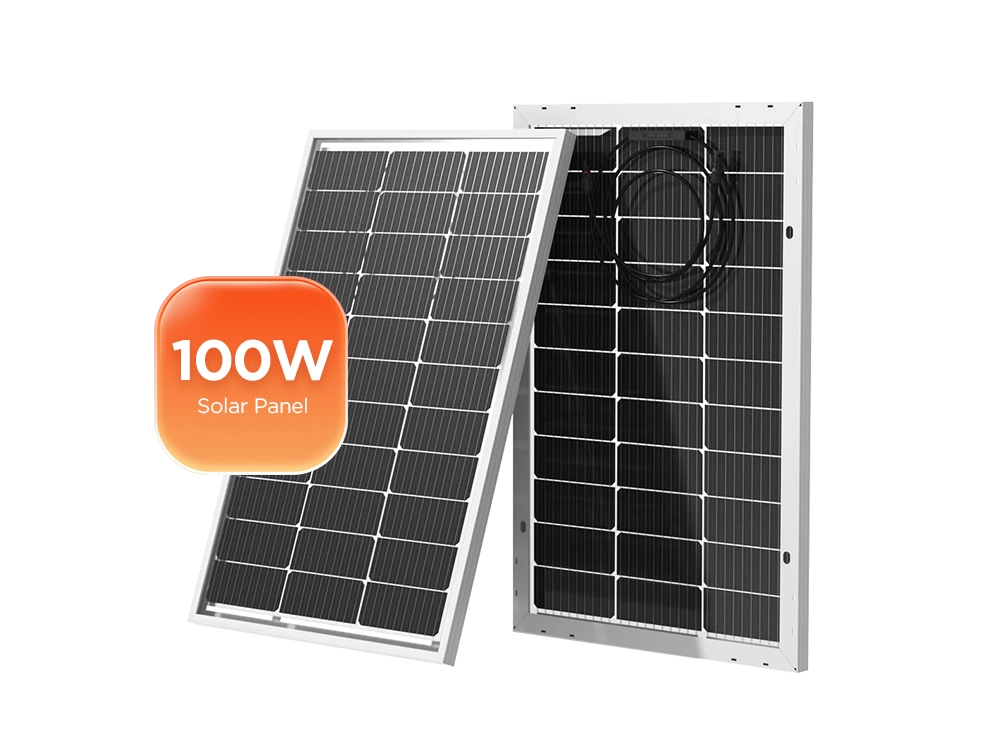
A 60W panel can theoretically deliver up to 60 watts under standard test conditions, while a 100W panel can deliver up to 100 watts. That does not mean either panel will continuously produce its rated output in real-world conditions.
Actual generation changes with:
- Solar irradiance
- Peak sun hours
- Panel orientation and tilt
- Temperature
- Partial shading
- Cable losses
- Charge-controller efficiency
- Battery charging conditions
For small off-grid systems, this difference becomes particularly important because every additional watt can contribute to battery recovery during limited sunlight hours.
| Factor | 60W Solar Panel | 100W Solar Panel |
|---|---|---|
| Rated output | 60W | 100W |
| Relative peak power | Lower | Higher |
| Typical application | Battery maintenance, light loads | Daily charging, larger loads |
| RV use | Compact setups | More energy-demanding setups |
| 12V battery charging | Suitable for smaller banks | Better for larger banks |
| Roof/space requirement | Lower | Higher |
| Energy reserve | More limited | Greater |
A 60W to 100W Monocrystalline Solar Panel therefore gives users a practical range rather than a one-size-fits-all solution.
Why Choose a Monocrystalline Solar Panel?
Cell technology matters just as much as wattage when installation space is limited.
Monocrystalline solar panels are widely used in residential, mobile, and off-grid applications because they offer strong power output relative to their physical footprint. This is particularly useful for RV roofs and boat decks, where available installation space can be more restrictive than on a conventional residential roof.
Modern 100W monocrystalline panels are commonly marketed for RVs, marine applications, cabins, and battery charging. Some current products also use half-cell or multi-busbar designs to reduce electrical losses and improve energy harvesting.
For a small system, this means the goal is not simply to maximize panel wattage. It is to maximize usable energy from the available mounting area.
Is 60W Enough for a 12V Battery?
A 60W panel can be appropriate when the objective is maintaining or gradually charging a smaller 12V battery rather than supporting heavy daily loads.
For example, it may be suitable for:
- Battery maintenance
- Small lighting systems
- Security cameras
- Basic electronics
- Small ventilation fans
- Low-consumption outdoor equipment
However, battery capacity matters.
A 12V 50Ah battery stores roughly 600Wh of nominal energy, while a 12V 100Ah battery stores approximately 1,200Wh. A 60W panel therefore represents a relatively small charging source compared with a larger battery bank.
The actual charging time also depends on battery chemistry, state of charge, sunlight conditions, and charge-controller efficiency. A 100W panel is generally better positioned for maintaining larger 12V battery banks because it provides more charging power under comparable conditions.
When Is a 100W Panel the Better Choice?
The 100W option becomes more attractive when energy consumption is no longer limited to occasional battery maintenance.
For example, an RV may use electricity for:
- A 12V refrigerator
- LED lighting
- Ventilation fans
- Phones and tablets
- Small electronics
- Water pumps
- Monitoring equipment
A 100W panel does not mean that all these devices can operate indefinitely from solar energy alone. Instead, it provides a larger daily energy contribution that can help replenish a battery bank.
Real-world examples show why application matters. Current 100W RV solar products are commonly positioned for battery charging, refrigeration, remote power, and small off-grid loads.
60W vs 100W for RVs: Which Makes More Sense?
For RV owners, the choice often comes down to available roof space and energy consumption.
A 60W panel may be enough when the RV has a small battery and relatively low electrical demand. It can also make sense as a supplementary charging source.
A 100W panel is generally more practical when the RV needs to recover more energy during the day.
| RV Requirement | Recommended Direction |
|---|---|
| Battery maintenance | 60W |
| Occasional camping | 60W–100W |
| Refrigerator support | 100W preferred |
| Multiple small electronics | 100W preferred |
| Larger battery bank | 100W or higher |
| Limited roof space | 60W may be easier to install |
The important point is that a solar panel should be matched to the energy budget of the RV, not selected based on wattage alone.
What About Boats and Off-Grid Cabins?
The same principle applies to marine and cabin applications.
On a boat, a small solar panel can help offset standby loads from batteries used for electronics, lighting, pumps, or refrigeration. A compact panel can also reduce how frequently the battery needs to be recharged from shore power or an engine-driven charging system.
For an off-grid cabin, the calculation is different. Lighting and small electronics may require relatively little power, while refrigerators, pumps, communication equipment, and other continuous loads can increase daily consumption significantly.
In either case, a monocrystalline solar panel should be selected according to the complete load profile.
How Much Energy Can a 100W Panel Produce?
A 100W panel does not necessarily generate 100Wh every hour.
A simplified estimate can be made using:
Daily energy ≈ Panel power × Peak sun hours × System efficiency
For example, assuming 100W of rated capacity, 4 peak sun hours, and 80% overall system efficiency:
100W × 4 × 0.8 ≈ 320Wh/day
This is only an example, not a guaranteed output.
Actual production can be significantly higher or lower depending on location, season, shading, temperature, orientation, and system losses. Some manufacturers cite approximately 500Wh per day for 100W panels under favorable conditions, but such figures should not be treated as universal.
This is also why solar buyers should be cautious about comparing products using only their peak wattage.
Which Panel Should You Choose?
The decision can be simplified into three questions:
Choose 60W when:
- Your energy demand is low.
- You mainly need battery maintenance.
- Installation space is very limited.
- Portability matters more than maximum output.
Choose 100W when:
- You have higher daily energy consumption.
- You need more reliable battery charging.
- You operate an RV refrigerator or similar load.
- You want additional energy margin during variable weather.
For users who are unsure, the 100W option generally provides greater flexibility, while 60W remains useful for compact, low-consumption systems.
Why Solvic’s 60W–100W Solar Panel Range?
Solvic’s 60W to 100W Monocrystalline Solar Panel range is positioned around practical small-scale solar applications, including RVs, boat batteries, refrigerators, and off-grid cabins.
This type of system is not intended to replace a large residential PV array. Its value lies in providing a compact and scalable source of solar energy where installation space and energy demand are both limited.
For users building a small 12V system, the right panel can make battery management easier while reducing reliance on shore power, generators, or conventional charging sources.
Conclusion
So, which is better: a 60W or 100W monocrystalline solar panel?
Neither is universally better.
A 60W panel makes sense for low-consumption applications and battery maintenance, while a 100W panel provides a larger energy margin for RVs, refrigerators, boats, and small off-grid systems.
The right choice ultimately depends on your battery capacity, daily energy consumption, available sunlight, installation space, and charging objectives.
With its 60W to 100W Monocrystalline Solar Panel solution, Solvic provides a practical option for users who need dependable small-scale solar power without moving to a much larger residential system.
FAQ
Q1: Is a 100W solar panel better than a 60W panel?
Not necessarily. A 100W panel can produce more power, but a 60W panel may be more appropriate when energy demand and installation space are limited.
Q2: Can a 100W solar panel charge a 12V battery?
Yes. A 100W panel can be used with a suitable solar charge controller to charge a compatible 12V battery. The charging rate depends on sunlight, battery capacity, battery chemistry, and controller efficiency. Current 100W 12V solar products are commonly designed for this type of application.
Q3: Can a 100W solar panel run an RV refrigerator?
It can contribute substantially to powering or recharging a battery system that supports an RV refrigerator, but whether it can offset the refrigerator’s full daily energy consumption depends on the refrigerator’s actual energy use and available solar generation.
Q4: What can a 60W solar panel power?
It is better suited to low-power loads or battery maintenance than high-consumption appliances. Applications can include small electronics, lighting, monitoring equipment, and other low-energy systems.
Q5: How much electricity does a 100W solar panel produce per day?
There is no universal figure. A simple estimate uses rated power, peak sun hours, and system efficiency. Weather, temperature, orientation, shading, and system losses can all significantly change actual production.
Q6: Are monocrystalline solar panels good for RVs?
Yes. Their relatively high power density makes them well suited to applications where roof or mounting space is limited. Current 100W monocrystalline products are widely marketed for RV, marine, and off-grid use.